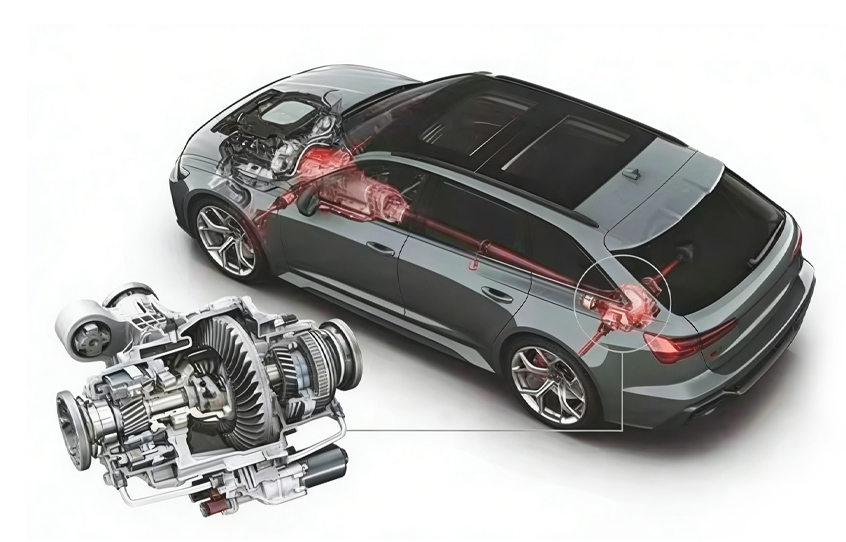
Many people mistakenly believe that "a longitudinal engine is more premium". In reality, neither layout is inherently superior. The core difference lies only in their mounting orientation, which directly affects vehicle space, handling and cost — they simply suit different scenarios. Choose transverse for family use and longitudinal for driving performance; understanding the differences will help you pick the right car.
Core definition: A transverse engine is mounted parallel to the front axle (wide and short), while a longitudinal engine is mounted perpendicular to the front axle (long and narrow). This difference determines the overall vehicle design and driving experience.
Transverse Engine: The Practical Choice for Daily Family Commuting
Transverse layout is the mainstream choice for family cars, with core advantages of practicality and high cost-performance.
It offers high space efficiency: a shorter engine compartment improves wheelbase utilization, resulting in a more spacious passenger cabin and trunk, making it ideal for daily family use. It also delivers excellent fuel economy. Paired with front-wheel drive, it has low power transmission loss (8%–10%), leading to better fuel efficiency, as well as lower manufacturing and maintenance costs. Its drawbacks are limited handling and lower maximum power potential: imbalanced weight on the front axle easily causes understeer; most models use simple MacPherson strut suspensions, making it difficult to fit large-displacement engines and complex four-wheel-drive systems. High-power versions also tend to suffer from torque steer.
Longitudinal Engine: The Performance Choice for Driving Enthusiasts
Longitudinal layout is commonly used in luxury and performance vehicles, with core strengths in superior handling and great power potential.
It easily achieves a 50:50 balanced weight distribution, ensuring stable cornering and precise steering. The generous lateral space allows for complex front suspensions, supports rear-wheel drive / four-wheel drive with no torque steer, and can accommodate large-displacement engines.
The disadvantages are low space utilization, as the engine bay reduces passenger and legroom, resulting in an uneven floor. The structure is complex, leading to higher costs and maintenance expenses, with slightly higher transmission loss (12%–15%) and moderately higher fuel consumption.
Choose based on your needs, not on perceived "status".
The difference between them essentially reflects automakers' trade‑offs among space, cost and performance. The key is suitability: choose a transverse layout for family use to meet daily commuting and travel needs; opt for a longitudinal layout for better driving control, ideal for highways and mountain roads.
Note: Some entry-level two-wheel-drive models from luxury brands use a longitudinal front-wheel-drive layout, which offers better handling than conventional transverse front-wheel-drive vehicles. In short, choose transverse for practical family use, and longitudinal for an enjoyable driving experience. Knowing your needs will help you select the right car.