
As the "heart" of a car, the engine’s cleanliness directly affects its operating efficiency and service life. Many car owners are confused by one question during vehicle maintenance: Can a car engine be directly washed with water? The answer is clear: it can be washed, but never recklessly or randomly, especially with blind high-pressure washing. Improper cleaning may result in minor engine malfunctions, or even severe damage to core components — making the loss far outweigh the gain. Today, we will break down the misconceptions and proper methods of engine water washing in detail, to help you safely care for your car’s "heart".
First, let’s correct a common misconception: the engine does not break down immediately upon contact with water. Its critical vulnerability is not that it “fears water”, but that it fears water getting into the wrong places. The engine bay contains not only the metal engine block, but also numerous electronic components, wiring harness connectors, sensors, and other parts. Once these components are exposed to water, problems such as short circuits, oxidation and corrosion will occur, which can further lead to engine failures including failure to start, rough idling and burnt electrical parts. This is the root cause of troubles many car owners experience after washing their engines with water.
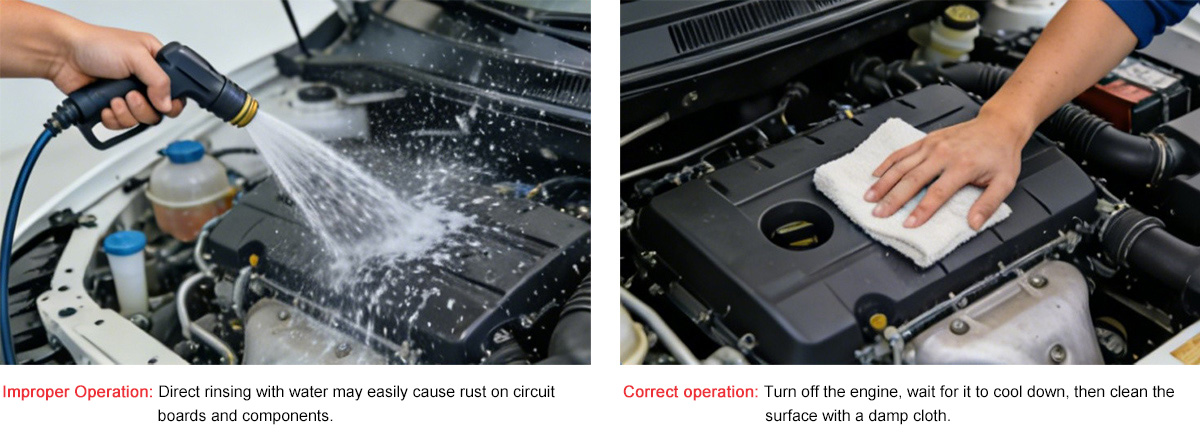
Let’s start with a dangerous mistake: spraying the engine directly with a high-pressure water gun. Many car owners, for the sake of convenience, blast the engine bay with a high-pressure water gun while washing their car, thinking this can quickly rinse away oil and dust. Little do they know, this practice involves multiple hidden risks. On the one hand, the strong impact of a high-pressure water gun can directly damage seals in the engine bay, such as those for wiring connectors, valve cover gaskets, and oil pan seals, leading to problems such as engine oil leakage and coolant leakage later on. On the other hand, high-pressure water can force its way into key components including the air intake, fuse box, ECU connectors, and alternator. If water cannot be drained in time, it will cause short circuits: in mild cases, burning out fuses; in severe cases, damaging the ECU (the "brain" of the car), with repair costs often ranging from thousands to tens of thousands of yuan.
Another easily overlooked mistake is rinsing the engine directly with water while it is still hot. After operation, the engine reaches a high temperature, and metal components such as the cylinder block and cylinder head can reach several hundred degrees Celsius. Sudden flushing with cold water at this point creates an extreme temperature difference, causing thermal expansion and contraction in the metal parts, which can easily lead to cracking and deformation — much like how scorching hot glass shatters when suddenly cooled. In addition, rubber components under high heat, such as water hoses and sealing gaskets, will age, harden and crack more quickly when exposed to cold water, shortening their service life.
So how can we safely wash the engine with water? The core principles are: perform when the engine is cold, use low-pressure washing, avoid electrical components, and dry promptly. The specific steps are simple and easy to follow, even for beginners.
1.Wait for the engine to cool down.
This is a critical prerequisite. Turn off the engine completely and let it sit for 1–2 hours until components such as the cylinder block and water hoses are no longer hot to the touch (at room temperature) before cleaning. This prevents component damage caused by extreme temperature differences.
2.Take proper protective measures.
Before rinsing, wrap key electrical components with plastic film or waterproof cloth. Focus on protecting these areas: the battery and its terminals, fuse box, ECU connectors, air intake, air filter housing, alternator, starter motor, as well as various sensor plugs and wiring harness connectors. These parts are “no-go zones” and must not be exposed to direct water contact. Once properly wrapped, you may proceed safely to the next step.
3.Low-pressure washing + special cleaning agent.
Use a low-pressure water gun (or a high-pressure water gun set to low pressure) together with a dedicated external engine cleaner. This type of cleaner effectively dissolves oil and dust in the engine bay without corroding metal or rubber parts.
First, spray the cleaner evenly over the entire engine bay and let it sit for 3–5 minutes to fully break down grease. Then rinse gently and diagonally from above the engine bay with low-pressure water, following the gaps between components. Avoid prolonged spraying on one spot to prevent damaging seals due to excessive impact.
4.Dry moisture thoroughly and promptly.
After rinsing, do not turn off the engine and park immediately. First, use an air gun (or a hair dryer on the cool setting if no air gun is available) to blow-dry moisture from gaps, plugs, terminals and other areas in the engine bay. Pay extra attention to drying residual water in protected components to avoid oxidation or short circuits.
Once dried, start the engine and let it idle for 5–10 minutes. Use the engine’s own heat to evaporate any remaining trace moisture. At the same time, check that the engine runs smoothly with no abnormal noise or vibration.
Here’s a professional and natural English translation for you: Let’s also talk specifically about the oil pan, which many of you have been concerned about. Many car owners worry that washing it with water will damage the oil pan, but there is really no need to fear this. As the component that stores engine oil, the oil pan is mostly made of aluminum alloy or cast iron, which has excellent water resistance and is not harmed by water washing. However, be careful not to direct a high-pressure water gun straight at the joint between the oil pan and the cylinder block, to avoid damaging the oil pan seal from the impact, which could lead to oil leakage later on.
In addition, several details should be noted: First, avoid using household cleaning products such as laundry detergent and dish soap. These are highly corrosive and can damage metal and rubber components in the engine bay. Be sure to use a dedicated external engine cleaner. Second, do not let water flow back into the air intake during washing, otherwise it will cause water ingestion into the engine. In severe cases, this can result in cylinder scuffing and complete engine failure. Third, if there is excessive grease and dirt in the engine bay, do not rinse it with water forcefully. It is recommended to manually remove most of the oil contamination first before washing, to prevent oil from clogging the drain holes.
To summarize: A car engine can be rinsed with water, but it must never be sprayed directly, let alone with high-pressure washing or done while the engine is still hot. By following the principles of washing when cold, using low pressure, avoiding electrical components, and drying promptly, you can safely clean the engine bay without damaging any parts, while keeping the engine in good running condition.
A reminder: If you are not confident in doing it yourself, do not wash the engine on your own, especially for luxury models or vehicles with densely packed electronic components. It is recommended to have it cleaned by professionals at a qualified auto maintenance shop. This ensures effective cleaning while avoiding damage caused by improper operation. After all, taking good care of the engine will keep your car running longer and more smoothly.